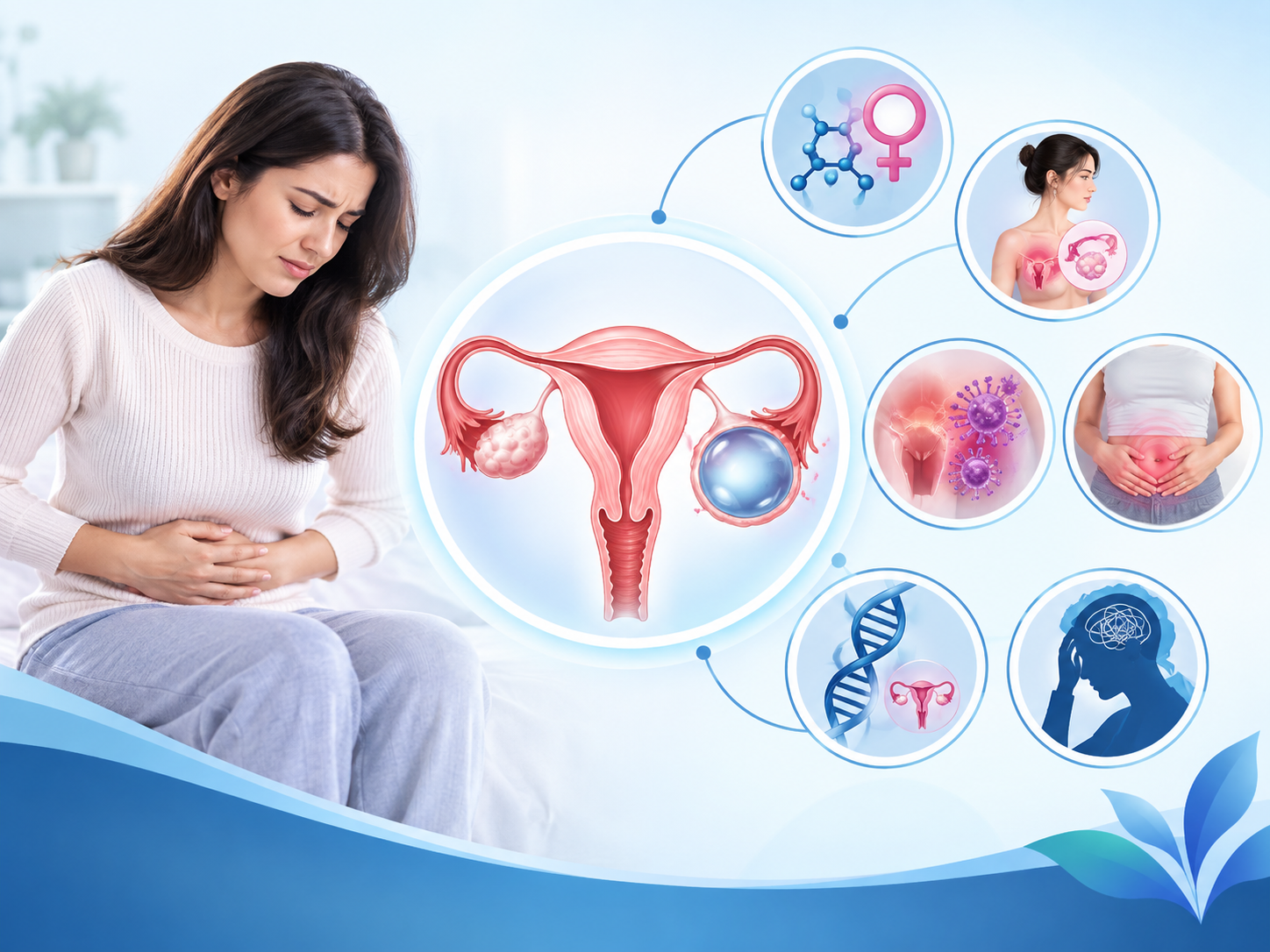
Ovarian cyst causes and symptoms: At least one in five women will develop an ovarian cyst at some point in their lifetime — and for the overwhelming majority, it will come and go without ever being noticed. That statistic alone explains why ovarian cysts generate so much quiet anxiety once someone actually is told they have one: the word “cyst” sounds alarming, but the reality for most women is closer to a routine, self-resolving footnote of a normal reproductive cycle. The genuinely useful skill isn’t worrying about cysts in general — it’s knowing which features separate the harmless majority from the smaller group that needs real attention.
Ovarian cyst causes and symptoms
Quick self-check: If you’ve been told you have an ovarian cyst, or suspect one, consider —
Is this your first cyst, found incidentally on a scan, with no pain or other symptoms?
Has it been present, unchanged, for less than a menstrual cycle or two?
Are you experiencing sudden, severe, one-sided pain, especially with nausea, fever, or dizziness?
Do you have other symptoms alongside it — irregular periods, excess hair growth, or noticeable pelvic pressure?
The first two point toward the common, self-limiting kind. The second two are exactly the pattern that warrants prompt evaluation — more on why below.
The Most Common Type: Functional Cysts
The majority of ovarian cysts are functional cysts, a direct byproduct of normal ovulation rather than disease. Each month, an ovary grows a small follicle that’s meant to rupture and release an egg. A follicular cyst forms when that follicle doesn’t rupture on schedule and simply keeps growing instead. A corpus luteum cyst forms afterward — once the follicle releases its egg and transforms into a hormone-producing structure called the corpus luteum, it can sometimes fill with fluid or blood rather than shrinking as expected. Both types typically resolve on their own within a few menstrual cycles, without any treatment.
Beyond the Functional Kind
Dermoid cysts (teratomas): Formed from the same germline cells that produce eggs, these can contain genuinely unusual tissue — hair, skin, or even teeth — and are rarely cancerous, though they can grow large enough to require removal.
Cystadenomas: Arising from cells on the ovary’s outer surface, these can be filled with watery or mucous material and are capable of growing quite large.
Endometriomas: Cysts formed when endometriosis-related tissue attaches to the ovary, often described by patients as “chocolate cysts” for their dark, old-blood appearance on imaging.
Polycystic-pattern ovaries: Seen in PCOS, where numerous small cysts form as part of a broader hormonal pattern rather than a single isolated cyst.
The Recognized Risk Factors
Research points to several factors that raise the likelihood of cyst formation: fertility medications that stimulate ovulation, pregnancy (where the original ovulatory follicle occasionally persists and enlarges), endometriosis, and a prior history of ovarian cysts.
A Rare but Genuinely Striking Complication
Reflect for a moment: Would you connect sudden seizures or confusion to an ovarian cyst? Most people wouldn’t — which is exactly why a documented, if uncommon, complication of dermoid cysts is worth knowing about. In rare cases, these cysts can trigger an autoimmune condition called anti-NMDA receptor encephalitis, in which the immune system’s response to the cyst mistakenly attacks the brain, producing psychiatric symptoms, confusion, headaches, and seizures. One reviewed case series found this occurred in under 1% of dermoid cyst patients — genuinely rare, but a useful reminder that ongoing follow-up after a diagnosed cyst isn’t just precautionary paperwork.
When Symptoms Signal an Emergency
Most cysts cause no symptoms at all, or at most a dull, intermittent ache. But larger cysts can cause bloating, pressure, or pain during intercourse. The complications that turn this from “watchful waiting” into an emergency are ovarian torsion (the ovary twisting on its supporting tissue, cutting off blood flow) and cyst rupture. Both can cause sudden, severe pelvic pain, and torsion in particular is a time-sensitive surgical emergency — sudden severe pain paired with nausea, vomiting, fever, or lightheadedness should prompt an immediate emergency room visit rather than a wait-and-see approach.
The Bottom Line
Most ovarian cysts are a normal, temporary byproduct of ovulation and resolve without any intervention. The key distinction is recognizing sudden, severe, one-sided pain—or a cyst that persists, grows, or comes with other hormonal symptoms—as a signal to seek prompt evaluation rather than assuming it will pass like the common kind.
One question worth asking at your next gynecology visit: If a cyst is found on your imaging, is it the common functional kind — and does it warrant a follow-up scan to confirm it’s actually resolving?
Leave a Comment